
Bramble and practicing collaboration without forced sharing
Neurodivergent children can learn collaboration without being pressured to hand over treasured toys. Try Bramble-inspired cooperative play activities that protect autonomy.
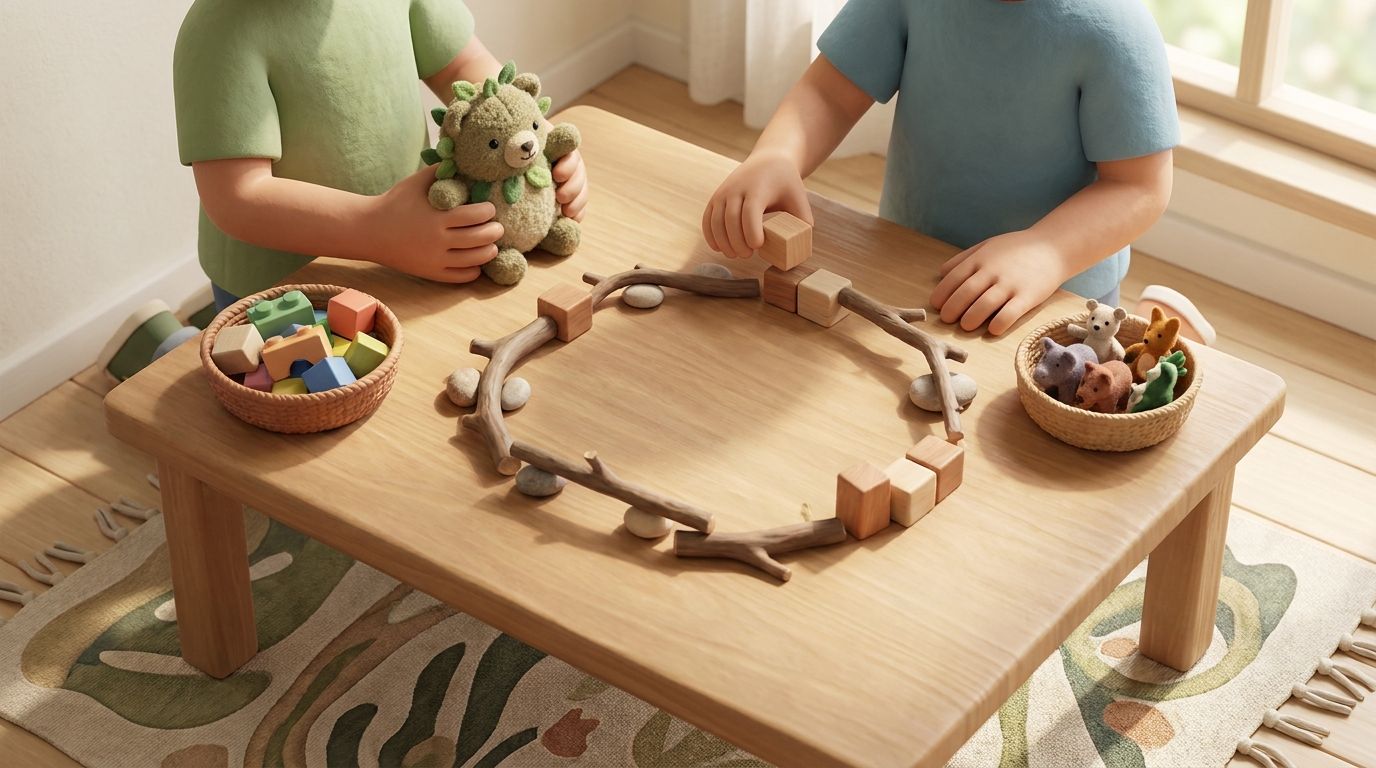
At 7:42 on a Tuesday morning, four-year-old Mateo is building a road from wooden blocks across the kitchen floor. His sister reaches for the long blue piece. Mateo pulls it close and says, "Mine." For neurodivergent children and sharing, that moment is not a character test. It is a chance to teach collaboration without forcing a child to give up control of a treasured object.
The most helpful shift is simple: treat sharing as one possible social skill, not the price of joining play. Collaboration can begin with taking turns, working beside someone, adding materials to a shared project, or agreeing on a plan. When you protect your child's right to say no, you give them safer practice with saying yes.
What collaboration actually asks of a child
Collaboration is not the same as handing over a toy. It asks a child to notice another person's idea, communicate a preference, tolerate a small change, and stay connected to a shared activity. Those demands can feel enormous when a child is tired, worried, sensitive to touch, or locked into a particular object.
A child may be ready to build a tower with you but not ready to let you move their favorite dinosaur. Another child may happily take turns during a predictable board game but panic when a sibling reaches into their open-ended art project. Both children are communicating useful information.
A 2020 review in Child Development Perspectives described play as a setting where children practice social understanding through repeated, meaningful experiences. The point is not that every child must perform the same social behavior. Practice works better when the child feels safe enough to stay involved.
You can look for collaboration in small actions:
- Your child places one block beside yours.
- Your child chooses which color you may use.
- Your child watches while you add one piece.
- Your child asks for a turn instead of grabbing.
- Your child leaves the activity and returns later.
That last one counts. Returning after a pause is often a sign that the activity still feels manageable. You do not need to turn it into a lesson with a proud announcement. A quiet "You came back" may be plenty.
Try describing what happened without judging it. "You kept the red truck, and you gave me the ramp." This helps your child notice the shape of cooperation without hearing that their worth depends on being agreeable.

Why forced sharing can make play harder
Picture six-year-old Priya at the library's children's table. She has spent ten minutes arranging magnetic tiles into a careful house. A younger child reaches over. The adult says, "Be nice. Share your house." Priya covers the tiles with both arms and stops talking.
The adult may be trying to teach kindness, but the message Priya receives can be something else entirely: other people can take what I am using, and my no will not be heard. For a child who already finds unexpected touch, noise, or interruptions difficult, that kind of pressure can push the nervous system past its comfortable range.
Forced sharing can also blur two separate ideas: generosity and surrender. Generosity means choosing to offer something. Surrender means giving something up because an adult demands it. Your child needs room to learn the difference.
Research on autonomy support, including work by Edward Deci and Richard Ryan, has found that people tend to engage more willingly when they have meaningful choices. That does not mean every household rule disappears. It means you can hold a boundary while still giving your child some control over how participation happens.
Instead of saying "You have to share," try:
- "The blue shovel is being used. You can ask when it is available."
- "You may keep the dinosaur in your lap. You can offer a different figure."
- "Your sister wants a turn. You can say yes, no, or not yet."
- "The timer is for waiting, not for taking the toy away."
You are not raising a child who never has to consider another person. You are helping your child learn that consideration goes both ways. Other people have needs, and your child has boundaries.
That balance matters beyond the playroom. A child who practices clear, respected limits has more room to negotiate, ask for help, and notice when another person needs space. Social connection should not require self-erasure.
Bramble's approach to cooperative play
Bramble is a useful guide here because the lesson is not "give everything away." The lesson is "find a way to be together that works for both people." You can bring that idea into play with a simple structure: protect, offer, connect.
Protect the item or activity your child is not ready to share. If the red train is off limits, place it in a safe spot and say so plainly. You are not rewarding selfishness. You are making the boundary visible, which can reduce grabbing and guessing.
Offer a small choice that does not threaten the boundary. Your child might choose whether you build the station or the bridge. They might decide which piece you may borrow. They might choose a timer, a song, or a verbal count before a turn changes.
Connect through a shared goal that does not depend on one person owning all the materials. Build a road to the sofa. Feed paper animals in a pretend café. Make a cardboard shelter for stuffed toys. The object becomes part of the activity, rather than the whole activity.
For five-year-old Jonah in Cedar Park, a train set was too personal to share at preschool pickup. His parent began putting out a second basket of plain blocks beside the train. Jonah kept the trains. His friend built a station. After several visits, Jonah started offering track pieces that were not part of his current route. No speech about kindness was needed. The arrangement gave cooperation somewhere to begin.
You can use Bramble's idea with a short phrase: "Your special thing can stay yours. Let's find the part we can do together." Say it before conflict rises, not while two children are pulling the same object. Calm preparation beats heroic refereeing every time, and saves at least one adult from crawling under the table after a runaway puzzle piece.
Cooperative play activities that do not require sharing
The best cooperative play activities give each child a role, a clear finish, and room to work separately. Shared ownership is not required. You can set up a joint project with duplicate tools or materials so that touching another child's work is optional.
Try a "two-lane build." Put two strips of cardboard on the floor. You build one road while your child builds the other. Add one shared destination, like a paper garage near the couch. Cars can travel together when both builders are ready. Your child can change lanes, pause, or watch without losing control of their own road.
Try "you choose, I place." Your child selects a block, puzzle piece, sticker, or craft shape. You place it where your child directs. Then you switch only if your child agrees. This creates collaboration through communication, not through taking.
Try a kitchen mission with separate jobs. Give your child a bowl and spoon while you handle the ingredients. Your child can stir dry oats, arrange napkins, or decide where the finished snack goes. Be mindful of allergies, heat, and choking risks. The social lesson is in coordinating jobs, not in producing a perfect snack.
Try a story relay. You say one sentence about a character walking into a forest. Your child adds what the character sees or does. If open-ended storytelling feels too large, offer two choices: "Does the character find a bridge or a cave?" Ziggyloo's StorySpark Studio can offer a similar space for shared story-making when your child enjoys creating with a screen and you can review the experience together.
Try a sound-and-movement plan. Your child chooses the music from a small set. You choose a movement. Switch roles after one song, or stop while it still feels good. Some children collaborate more easily through rhythm than through spoken negotiation.
Keep the project short enough that success arrives before fatigue. You can stop after six blocks, one song, or five minutes. Ending with "That worked for today" protects the next attempt.
What to say when your child says no
A refusal gives you information. It does not automatically need correction. Your child may be protecting a special interest, avoiding an unpredictable change, or telling you that their body has reached its limit.
Start by accepting the boundary. "You do not want me to touch the tower." Then name the other person's need without making your child responsible for fixing it. "Mina wants to play nearby." Offer a path that keeps both facts true.
Useful scripts include:
- "You can keep that piece. Would you like to build beside Mina?"
- "Not yet is an answer. We can set a time to check again."
- "You can show me where the piece goes, or I can watch."
- "You do not have to share your special item. Let's find a community item."
- "Your body is saying stop. I will help you make space."
For eight-year-old Amara, the difficult part of board games was not losing. It was other players touching her cards. Her parent introduced card stands and a rule that each player handled only their own cards. Amara could ask for help when she needed a card read. She began playing for longer because the physical boundary was clear.
You can also teach a repair phrase after a grab or a shout. Keep it brief: "I took that. I am putting it back." A repair does not need a forced apology, eye contact, or a long explanation. The action matters more than a polished performance.
If another child is upset, you can support both children. "You wanted the truck, and Amara was using it. We are going to wait for a turn." This is not taking sides. It is making the limit predictable.
When collaboration falls apart
Collaboration will sometimes end in yelling, hiding, grabbing, or tears. That does not erase the practice that came before it. A child who managed four minutes of shared play before needing space may have reached a real limit, not failed the activity.
Reduce the social demand before you add more teaching. Move the materials apart. Lower your voice. Remove the audience when possible. If your child is hitting or throwing, block the action and keep everyone safe with as few words as you can manage.
Then check the conditions. Ask yourself:
- Was the activity too long?
- Was the material too special to place in shared space?
- Did another child change the plan without warning?
- Was the room loud, crowded, or physically uncomfortable?
- Did your child have a way to pause?
The answer can guide the next setup. You might use duplicate materials, a visual timer, a quieter room, or a clear "finished" basket. You might practice with one trusted adult before inviting a sibling or friend.
Avoid processing the whole event while your child is still flooded. Later, you can say, "The tower fell when the pieces moved. Next time, we can put your special blocks in the safe tray." This gives your child a concrete adjustment rather than a lecture about behavior.
If collaboration is repeatedly painful across home, school, and community settings, share specific observations with your child's teacher, occupational therapist, speech-language pathologist, or pediatrician. Describe what happens before, during, and after the conflict. "Does not share" is too broad to guide support. "Covers ears when three children reach for the same bin" tells a much clearer story.
Making collaboration part of everyday life
You do not need a weekly social-skills class in your living room. Ordinary routines already contain small chances to coordinate. Folding towels can become a matching job. Packing a bag can include choosing who carries which item. Watering plants can involve one person filling the cup and another checking the soil.
Choose one routine your child already tolerates. Add one shared decision, not five new demands. Six-year-old Ellis and his mother began making toast together on Saturday mornings. Ellis chose the plate and carried the napkins. His mother handled the toaster. After a month, Ellis started asking his mother which topping she wanted. The collaboration grew from a predictable job with a clear boundary, nothing more complicated than that.
You can keep a tiny record of what helped. Note the activity, the length of time, and the type of support. You may notice that your child collaborates longer after movement, with parallel work, or when the ending is announced early. Parent-visible transcripts in Ziggyloo's AI learning companion can also help you notice how your child responds to prompts over time, if you use the app as part of your routine.
Celebrate the process with precise language:
- "You told me where to put the piece."
- "You kept your train safe and made room for my bridge."
- "You asked for a pause before your body felt too full."
- "You came back and chose a new plan."
Do not measure progress by whether your child gives up a favorite item on command. Measure it by whether your child can communicate, recover, negotiate, or stay connected in a way that feels safe enough. That is real collaboration.
Your next step can be tiny. This week, set up one five-minute activity with duplicate materials, a protected special item, and two possible roles. Say, "Your thing can stay yours. Let's choose one thing to do together." Then follow your child's answer.
FAQ
How can I teach sharing to a neurodivergent child without forcing it?
Start with consent and predictable turns. Let your child protect special items while practicing with community materials, duplicate toys, or short cooperative projects. Use phrases such as "not yet," "my turn after yours," and "you can choose another piece."
What is the difference between sharing and collaboration?
Sharing usually means allowing another person to use an object. Collaboration means working toward a shared activity or goal, and it can happen without giving up ownership. Building beside someone, choosing roles, and taking turns with agreed materials are all forms of collaboration.
What are good cooperative play activities for neurodivergent children?
Try two-lane building, shared cooking jobs, story relays, movement games, and "you choose, I place" activities. Keep the activity brief, make roles clear, and provide duplicate materials when touching another child's work may feel stressful.
Should my child have to share at school or playdates?
Your child can be expected to follow safety rules and respect another child's active use of an object. They do not need to surrender every personal or special item. Adults can create turn-taking plans, shared-material stations, and protected spaces so children practice cooperation without forced sharing.
What should I do when my child grabs a toy?
Block the grab calmly, return the item when safe, and name the boundary: "That toy was being used." Then offer a short script such as "Can I have a turn?" or provide another role nearby. Practice the repair later, once your child is calm enough to think.
Join the conversation
Subscribe to comment
Join the Ziggyloo family newsletter to leave a comment — and get gentle learning tips and community stories in your inbox. No spam, unsubscribe anytime.