
Korra and visual steps for transitions before the meltdown starts
When transitions start feeling like a trap, Korra-style visual steps can buy you time. Use a simple visual schedule to prevent meltdown spirals.
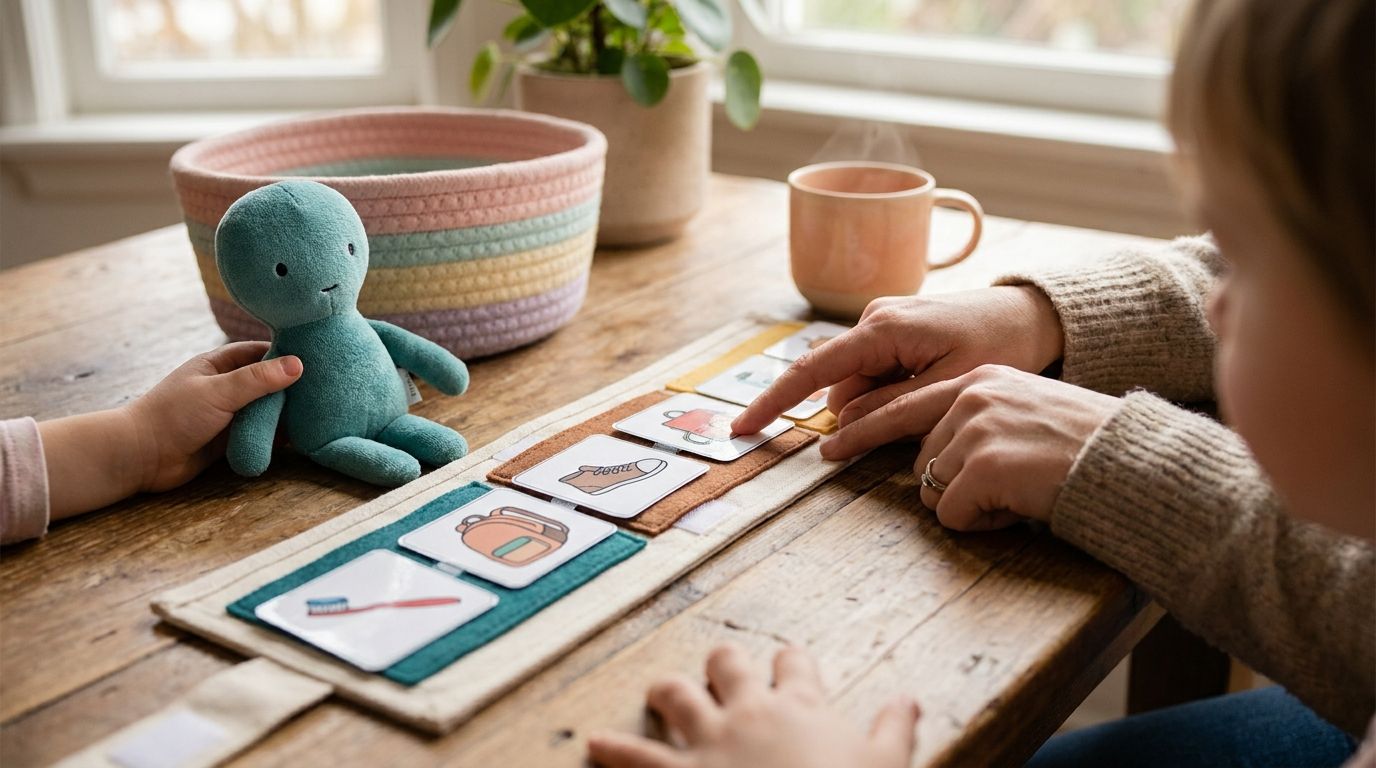
You're in the kitchen when the timer goes off. You say, "Okay, time to get shoes on," and your child's face changes fast. Not defiance. Not laziness. Something in their brain is already slipping out of gear.
This post is about using Korra to make transitions easier before the meltdown starts. You'll build a visual schedule with "visual steps" that supports executive function, helps with autism and ADHD supports, and reduces the odds that a transition turns into a full-on meltdown prevention situation.
And yes, you will still have hard moments. But you'll also have tools that work when you can't talk your way out of it.
Why transitions tip kids into meltdown mode
Transitions look small from the outside. A switch from play to dinner. A car ride to school. A bedtime routine that starts with pajamas.
Inside many neurodiverse kids, though, transitions can hit like a wall. Their brain has to stop one activity, hold a new plan in mind, and figure out what comes next. That is executive function work. It is also working memory work. And it is often sensory work too.
When that load gets heavy, you might notice a pattern like this:
- They start stalling right before you even ask.
- They get louder or quieter in a way that feels "off."
- They argue about tiny details that do not matter.
- They melt down faster than usual for the same request.
This is why "just wait a minute" rarely helps. The plan is already breaking down. Research on executive function and self-regulation in ADHD and autism keeps pointing back to the same practical idea: kids do better when the next step is made clear, predictable, and visible, not only spoken.
A 2015 review in The Lancet Psychiatry discussed how executive function difficulties are common in ADHD and how supports that reduce cognitive load can improve daily functioning. For autism, many support approaches lean on visual structure because it lowers the guesswork.
So your goal is not to talk them into it. Your goal is to make the transition easier to process.

Meet Korra: the "next step" character spotlight
Korra is a Blue Dragon in the Ziggyloo world, and her superpower is making the next step feel reachable. That matters because transitions are not one moment. They are a chain.
When kids struggle with transitions, the chain is where things snap. Spoken instructions are a chain too. You say, "Shoes on, then we go." Your child has to hold both steps in their head while their body is still trying to finish the current activity. That is a lot.
Korra-style "visual steps" change the chain into something you can point at. Something visible. Something that does not require your child to remember the whole plan while they are already stressed.
Here is what "visual steps" look like in real life. You do not need fancy tech.
You need three things:
- A small visual schedule that shows the order.
- A "right now" cue that tells them which step is active.
- A clear finish cue that tells them the transition is done.
That last part is underrated. Many kids melt down because they think the change has no end. A finish cue tells the nervous system, "We're not trapped here."
Try this script when you set it up. Keep it boring and consistent:
- "We are doing step one now."
- "When step one is done, we do step two."
- "When step three is done, you get back to your game."
You are not bargaining. You are guiding, and you are doing it in a way that supports executive function. Your child does not have to hold the whole plan; they can follow what is right in front of them.
How to build a visual schedule that actually prevents meltdowns
A visual schedule is not a poster that lives on the fridge and never gets used. It is a tool you update and point to during the moment.
Start with a short transition. Pick one that reliably triggers a meltdown, like leaving the house or switching from screen time.
Then build your schedule around that transition.
A simple "before meltdown" template
Use this template for almost any routine:
- Step 1: Finish the current activity (time or choice).
- Step 2: Transition task (what to do next).
- Step 3: Start the new activity (what happens after).
You can make it on paper, card stock, or sticky notes.
If your child likes order, lay the cards left to right. If they get overwhelmed by too much, keep it to three cards and move them one at a time.
Three concrete scenarios you can copy
Scenario 1: After-school meltdown at the front door
Moment: You open the front door and your child's backpack is still half on.
What you do with visuals:
- Put three cards by the door: "Backpack," "Snack," "Coat off play."
- Point to "Backpack" as soon as you walk in.
- When it's done, flip the cards so "Snack" is "right now."
Why it works: you are reducing the executive function load. Your child does not have to remember what comes next while they are still flooded from school.
Scenario 2: Preschool-to-car transition with sensory friction
Moment: Your child freezes when you say "car seat."
What you do with visuals:
- Create a visual schedule with: "Car seat," "Seat belt click," "Song or audiobook."
- Use a "right now" cue card that you hold up.
- Keep the "click" step visible so you can celebrate it.
Why it works: sensory and timing stress drops when the next step is predictable. You also get a concrete win to aim for.
Scenario 3: Bedtime switch when the lights go off
Moment: You say "brush teeth," and suddenly bedtime becomes a battle.
What you do with visuals:
- Use a three-step visual schedule: "Toothbrush," "Pajamas," "Story lights out."
- Put the cards on the bathroom wall.
- Move the "right now" card each time you finish a step.
Why it works: it prevents the "what happens next" panic. It also helps kids with autism and ADHD supports because the plan is visible, not only spoken.
A quick note about timing
Visuals work best when you start them before the emotional surge. If you wait until your child is already melting down, they usually cannot access the plan.
So you are aiming for "before the meltdown starts," not "during the meltdown." (I know. Easier said than done on a Thursday afternoon.)
"Visual steps" you can use in the moment, not just as a chart
You can have a visual schedule and still get stuck if you do not use it actively.
Here are "visual steps" that you can do while you're standing in the hallway or kitchen.
1) The pause-and-point move
Instead of repeating instructions, pause. Point to the active step.
Try it like this:
- Pause for one breath.
- Point to "Step 2: shoes."
- Say, "Shoes now."
Then stop talking. Let the visual do the work.
2) The "show me first" switch, but for transitions
Some kids can freeze when you say "do this." You can flip it.
- You show the first step on the spot.
- Then you point to the visual step card.
Example: When leaving after dinner, you put on your own shoes. Then you point to "Shoes on" and let your child copy. This reduces the executive function demand of "figure out how to start."
3) The finish cue that ends the fear
Many meltdowns are about ending. Your child fears that the transition has no clear stopping point.
Add a finish cue card like "Back to play." Put it last.
When you flip to that card, you do not add new instructions. You let that card mean what it says.
4) The two-choice card for compliance without bargaining
If your child fights the step, offer two options that still keep the transition on track.
Make a card with two pictures:
- "Red cup or blue cup"
- "Coat on or jacket on"
You are not negotiating the transition. You are giving control inside the structure.
5) A "reset" visual for when you miss the moment
Sometimes you will. You will be tired. You will forget. Your child will melt down anyway.
When that happens, you can still use visuals to recover:
- Put the schedule back at Step 1.
- Use a calm phrase: "We start again."
- Keep the steps shorter the next try.
That is not failure. That is learning.
With Ziggyloo's adaptive learning system, you can also match routines and supports to your child's needs so the transition plan fits their mood and processing speed.
Autism and ADHD supports: what changes when the brain is overloaded
Transitions are different for every child. But there are patterns that show up again and again for autism and ADHD supports.
When autism is part of the struggle
Some kids need predictability more than reassurance. If the routine changes, even slightly, they can feel genuinely unsafe.
Visual schedules help because they remove uncertainty. Try these tweaks:
- Use the same card order every day for a given routine.
- Keep language short: "Now shoes." "Next car seat."
- If you know a change is coming, add a "change card" early, like "Today: different route."
When ADHD is part of the struggle
Some kids are not avoiding. They are getting pulled by the present moment, their brain is seeking stimulation, not resisting you.
Visual steps help because they create an external guide. Try these tweaks:
- Use a timer with the visual schedule so "finish the current activity" is concrete.
- Make steps tiny, like "Backpack zipper" instead of "Get ready."
- Keep the schedule in the place where the action happens, not across the house.
A practical "executive function" rule
If your child can only handle one thing at a time, your transition visuals should reflect that.
So if you currently say: "Shoes, then backpack, then car seat," switch to:
- "Shoes now."
- Then, when shoes are done, show "Backpack now."
You are giving their executive function less to hold.
And yes, it takes longer at first. It also saves you time later when you are not stuck in meltdown prevention mode.
Common mistakes that make transitions harder (and what to do instead)
You are not doing these things because you want your child to suffer. You are doing them because you are doing your best.
Still, these mistakes are common.
Mistake 1: Giving the whole instruction list at once
If you say, "Shoes on, then socks, then in the car, and don't forget your water," you are asking for too much working memory all at once.
What to do instead:
- Use one step at a time.
- Point to the "right now" card.
- Add the next step only after the first is done.
Mistake 2: Waiting until the child is already dysregulated
If your child is already melting down, their brain is not in "follow instructions" mode.
What to do instead:
- Start the visual schedule early.
- Do it before you ask for the change.
- Keep the steps visible until the transition is complete.
Mistake 3: Making visuals too detailed
A visual schedule with ten steps can become another source of stress.
What to do instead:
- Keep it to three steps for most transitions.
- Use one card per action.
- Add detail only if your child handles it calmly.
Mistake 4: Using visuals as a threat
If the schedule becomes punishment, it will lose its power.
What to do instead:
- Treat the schedule like a bridge.
- Move cards calmly.
- Celebrate the finish cue.
Mistake 5: Not updating after a rough day
If the schedule fails once, you do not blame your child. You adjust the plan.
What to do instead:
- Shorten steps.
- Add a sensory break card if needed.
- Try the same routine at a calmer time first.
FAQ
How do I start a visual schedule if my child refuses charts?
Start with something smaller than a chart. Use three sticky notes for one transition and point to them during the moment. If your child ignores the paper, you can still move the cards yourself and treat it as your guide, not their test.
What should I do if the meltdown already started?
Lower the demand. Stop adding new instructions. Move back to the earliest possible step and use simple language like "We start again." Then try the visual steps earlier next time.
Do visual steps work for both autism and ADHD supports?
Yes. Visual structure helps reduce uncertainty for autism and helps guide attention and executive function for ADHD. The biggest difference is how you pace the steps and whether you add a timer.
How long should a visual schedule be for transitions?
For most kids, three steps is a sweet spot. If your child struggles, use two steps. If they handle it well, you can add one more step later.
What if my child says "I don't want to" after I show the visual steps?
That can still be communication, not defiance. Offer two choices inside the next step, keep language short, and point to the "right now" card. You are guiding the transition, not debating it.
Your next step
Pick one transition that reliably sparks a meltdown. Make a three-card visual schedule for it today. Point to the "right now" card at the moment you first notice resistance, before the emotional surge hits.
Then do one tiny adjustment after the first try. You're building a bridge, not a perfect plan.
Join the conversation
Subscribe to comment
Join the Ziggyloo family newsletter to leave a comment — and get gentle learning tips and community stories in your inbox. No spam, unsubscribe anytime.