
Character spotlight: Smolder and helping kids notice their energy before it spills over
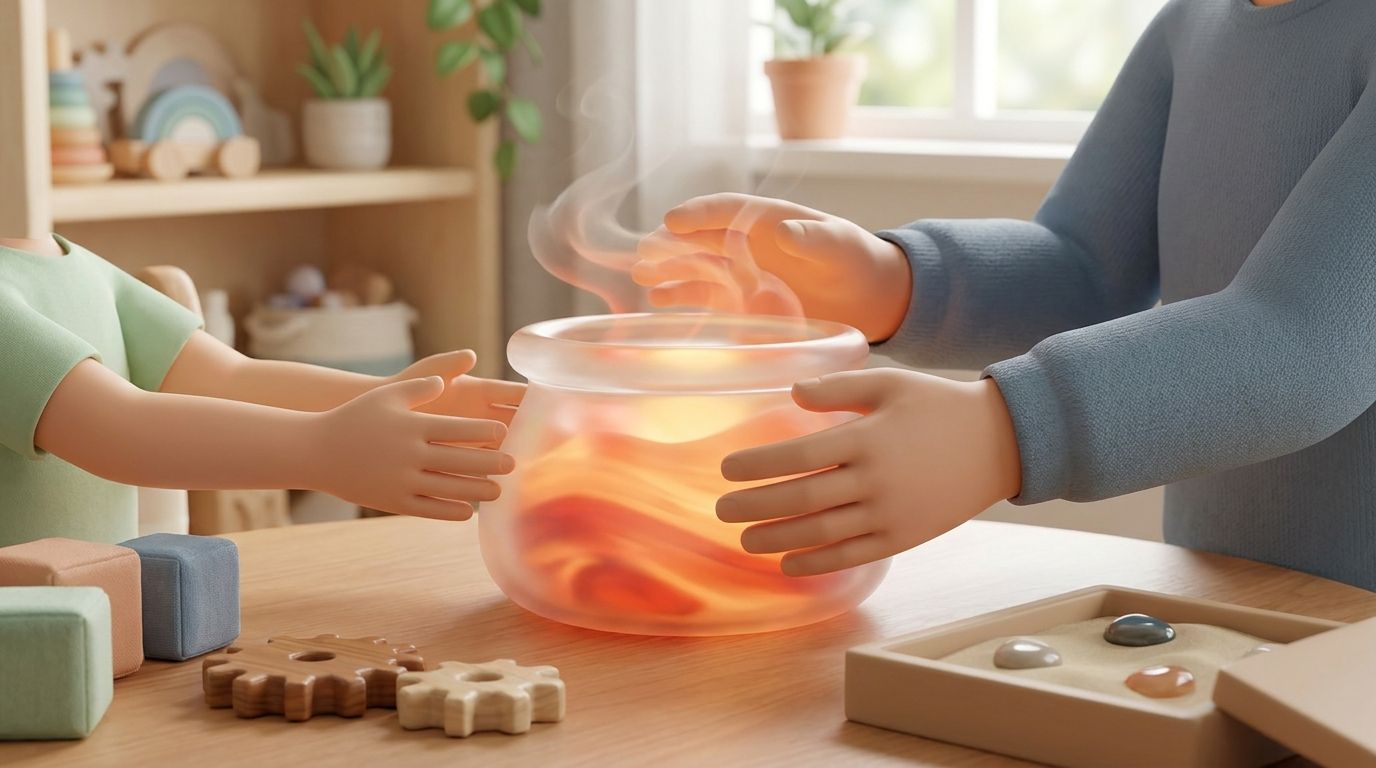
Smolder helps you spot the early body signals of overwhelm, so emotional regulation can begin before the shouting, throwing, or shutdown.
The cereal bowl hit the table at 7:42 a.m. Not across the kitchen, thankfully, but hard enough to splash milk onto the placemat. Your child's shoulders were up by their ears, their hands were tight fists, and the question about socks had somehow become the final straw.
This is where body signals activities for children can help. When you teach your child to notice heat, tight muscles, fast breathing, noise sensitivity, or a busy brain before the full spillover, you give them an earlier place to ask for support. Smolder helps you make that early moment visible without treating big feelings as bad behavior.
Smolder is the Gloom connected with rage and frustration. Vollo, his evolved form, represents resilient strength. Together, they offer a useful message for emotional regulation for neurodivergent kids: the goal is not to make anger disappear. The goal is to notice what the body is saying soon enough to choose what happens next.
What Smolder helps you notice before the blow-up
A child may not say, "My nervous system is overloaded." Most adults would struggle to say that while hunting for a missing shoe, and we have access to coffee. Your child may show the message through movement, sound, silence, refusal, or a sudden need to control one tiny detail.
Helping children recognize overwhelm starts with observing patterns without blame. You are not building a case against your child. You are learning their early signals.
Why does my child seem fine until they suddenly explode?
A child can miss or hide early signs of overload until the body reaches its limit. Neurodivergent children may also spend energy holding themselves together at school, then release that effort at home where they feel safer.
Look back at the ten minutes before the hard moment. You may notice a pattern such as:
- Faster movements, louder speech, repeated questions, or rougher play
- Hands covering ears, pulling at clothing, chewing, pacing, or crashing into furniture
- A face that looks flushed, pale, tense, or unusually still
- Refusing a familiar task, arguing over small details, or saying "no" to every offer
- Losing access to words, eye contact, humor, or the ability to follow a simple direction
These signs are not a diagnosis. They are clues about what support might help right now. The same child may look restless when they need movement and quiet when they are already past their limit.
Try writing down three details after a difficult moment: what happened before, what you saw in the body, and what helped even a little. You do not need a perfect chart. A note on your phone counts. So does a scribble on the back of a grocery receipt.
Body signals activities for children that feel playful, not like a test
Body awareness works better when it is practiced during calm moments. You cannot teach a fire drill while the smoke alarm is blaring. Pick one activity, keep it brief, and stop while it still feels easy.
The body detective game
Invite your child to become a body detective while you model the activity yourself. Say, "I notice my shoulders are high," or "My breathing got faster when we were late." Then offer a few neutral choices:
- Is your body loose, tight, wiggly, heavy, hot, cold, or buzzy?
- Is your energy low, medium, high, or too high for this moment?
- Does your body want space, pressure, movement, water, quiet, or help?
You can use hand signals, pictures, or objects instead of spoken answers. A child does not need to name an emotion to communicate a need. "Hot hands" or "too loud" may tell you more than a forced feeling label.
Keep the language concrete. "Your body looks tight" is usually more useful than "You are dysregulated," a word that belongs in a professional note, not beside a tired child in the hallway at 6 p.m.
The energy meter
Draw a simple meter with four zones: low, ready, high, and spilling. Add colors only if your child likes colors. Some children prefer numbers, animal movements, or weather pictures. The format is less important than having a shared way to check in.
Practice when nothing is wrong. After breakfast, ask where everyone's energy sits. Before leaving for school, check again. At bedtime, notice what helped the body move toward rest.
Your child might point to "high" and still be able to get dressed. That is useful information, because you can offer a small adjustment before the body reaches "spilling."
Copy the signal
This activity takes less than a minute. You make a gentle movement, and your child copies it if they want to. Try pressing palms together, stretching fingers, rolling shoulders, or taking one slow sip of water. Then pause and notice whether the body feels the same or different.
There is no prize for the deepest breath or the calmest pose. Some children become more distressed when adults ask them to breathe slowly. In that case, try pushing against a wall, carrying books, stomping on a taped floor path, or shaking out hands.
Movement is not a reward for good behavior. It is one possible way to give a busy body a safer job.
Helping children recognize overwhelm in real life
Practice needs to travel beyond the living room. The grocery store, car, classroom doorway, sibling bedroom, and dentist's office all bring different demands. Your child may know the energy meter at home but lose access to it when lights, voices, waiting, and transitions pile up.
That does not mean the practice failed. It means you may need fewer words and a faster support plan.
Why do body signals matter during a meltdown?
Body signals matter because early support is easier to use than a lesson delivered after a child has lost access to language and flexible thinking. Once the body is in full alarm, safety and connection come before teaching.
When you see early signs, try this sequence:
- Lower your voice and use one short sentence
- Reduce demands, questions, noise, and extra movement around your child
- Offer two concrete choices, such as "quiet corner or car?"
- Add a familiar body support, such as water, pressure, movement, a hat, or headphones
- Wait before discussing what happened or asking for an apology
Your words can be simple: "Your body is getting too full. I'm here. Quiet or outside?" The point is not to win agreement. The point is to make the next safe step easier to find.
Some children need closeness. Others need distance. A child who pushes you away may still need help, just not touch. You can stay nearby, keep your face relaxed, and protect the space without demanding eye contact.
A small plan for common moments
Choose one setting that often goes sideways. Maybe it is the end of screen time, getting into the car, homework, or leaving a birthday party. Write a plan with three parts:
- Early signal: "Hands cover ears and speech gets sharp."
- Parent response: "I use fewer words and offer a quiet break."
- Return step: "We restart with shoes, water, then one direction."
Share the plan with another adult who supports your child. A teacher, grandparent, or after-school caregiver does not need a long explanation. They need to know what to watch for and what response is more helpful than "Calm down."
You can also make a pocket version with three pictures. One picture shows the signal. One shows the break. One shows the return. If reading is hard under stress, the pictures carry the plan.
ADHD emotional regulation strategies that leave room for the real child
ADHD emotional regulation strategies work best when they account for attention, impulse control, sensory needs, sleep, hunger, and transitions. A child who is calm at 9 a.m. may have far less room for waiting at 4 p.m. That is not a character flaw. The available fuel has changed.
The same is true for autistic children and children with other neurodevelopmental differences. A crowded day can create a delayed reaction, so the difficult moment may happen at home after your child has spent hours adapting to noise, social demands, movement, or confusing instructions.
Try building support into the day before it is needed:
- Offer movement before a seated task, not only after restlessness begins
- Give a visual warning before transitions, with one clear next step
- Keep a snack and water available when hunger makes every demand feel enormous
- Use short directions and pause long enough for processing
- Plan a quiet arrival after school before questions, chores, or homework
- Protect sleep routines where possible, since tired bodies have less room for frustration
"Before it spills over" does not mean you must catch every signal. You will miss some. Everyone will. The aim is to increase the number of moments when your child gets support earlier, not to create a flawless household where nobody ever yells.
Ziggyloo can give you another low-pressure place to practice noticing patterns through its adaptive learning companion, story library, and games. Parent-visible transcripts can help you see which words or topics your child returns to, but your own observations remain important. An app cannot see the tight jaw in the back seat or the way socks suddenly feel unbearable.
Smolder can also help you talk about frustration without making the conversation about blame. You might say, "Smolder is getting hot. What does your body do when frustration starts?" Then wait. Your child may answer with words, a gesture, a drawing, or a refusal. That response still gives you information.
What to do after the energy spills over
Repair does not need to look like a lecture. After your child is safe and more settled, start with connection: "That was a lot. I stayed with you. We can figure out the next part."
If something was damaged or someone was hurt, repair still matters. Keep it concrete and within your child's capacity. You might help clean the milk, bring an ice pack, draw an apology, or practice the next request. A child can take responsibility without being shamed.
Later, revisit the moment when both of you have more room. Ask one question, not ten. "What did your body notice before the bowl hit the table?" If your child does not know, offer possibilities based on what you saw: "Were your hands tight, your ears sore, or your body too fast?"
Make a note of what worked. Maybe the hallway was quieter. Maybe the choice of car or couch prevented another argument. Maybe nothing worked until the lights were dimmed. That is not a wasted attempt, it is information for the next day.
Vollo's resilient strength is a helpful reminder here. Resilience is not the ability to tolerate endless demands without reacting. It is the chance to recover, try a different support, and return without losing dignity.
What can you say in the moment?
Keep a few phrases ready so you do not have to invent calm language while your own nervous system is doing cartwheels:
- "I see the energy getting high. I'm staying close."
- "You do not have to explain yet."
- "Quiet or movement?"
- "I will keep the space safe."
- "We can try again when your body has more room."
These sentences do not excuse hitting, throwing, or unsafe behavior. They separate the need for safety from the need to punish. You can block a hit, move objects, and hold a firm boundary while keeping your voice steady.
And if you lose your patience, repair that too. "I shouted. That was too loud. I'm going to try again." Your child learns that regulation is a practice for grown-ups as well. Mine certainly is. (I once tried to model a calming breath while carrying six grocery bags and stepped directly on a squeaky toy. The lesson was not graceful, but the repair was real.)
FAQ
What are good body signals activities for children?
Try an energy meter, body detective check-in, movement copying, or a simple choice between quiet and movement. Practice during calm times and accept gestures, pictures, or actions as communication.
How can I help my child recognize overwhelm before a meltdown?
Watch for repeated early signs such as faster movement, tight hands, louder speech, covering ears, refusal, or loss of words. Reduce demands and offer a familiar support as soon as those signs appear.
What helps with emotional regulation for neurodivergent kids?
Short directions, predictable transition warnings, movement, sensory adjustments, food, water, sleep support, and calm adult presence can help. The best combination depends on the child and the setting, so track what helps instead of expecting one trick to work every time.
Are these ADHD emotional regulation strategies useful for autistic children too?
Yes, many strategies can help across neurodevelopmental differences, but each child's sensory and communication needs are different. Offer choices, avoid forcing eye contact or breathing exercises, and treat the child's behavior as information about support needs.
Before tomorrow's busiest moment, choose one signal to watch for and one response to try. Put both on a note by the door. You are not trying to prevent every hard feeling. You are helping your child meet that feeling a little earlier, with a little more support, and with far less shame.
Join the conversation
Subscribe to comment
Join the Ziggyloo family newsletter to leave a comment — and get gentle learning tips and community stories in your inbox. No spam, unsubscribe anytime.