
Character spotlight: Wix and confidence building activities for kids
Wix shows how gentle experiments can help neurodivergent children build confidence without turning every try into a test.
At 7:42 on a Tuesday morning, Rowan stood beside the kitchen table with one sock on, a paper bridge in one hand, and a very serious frown. The bridge had collapsed twice. When his mum suggested trying a wider base, Rowan pushed the paper away and said, "I'm bad at this."
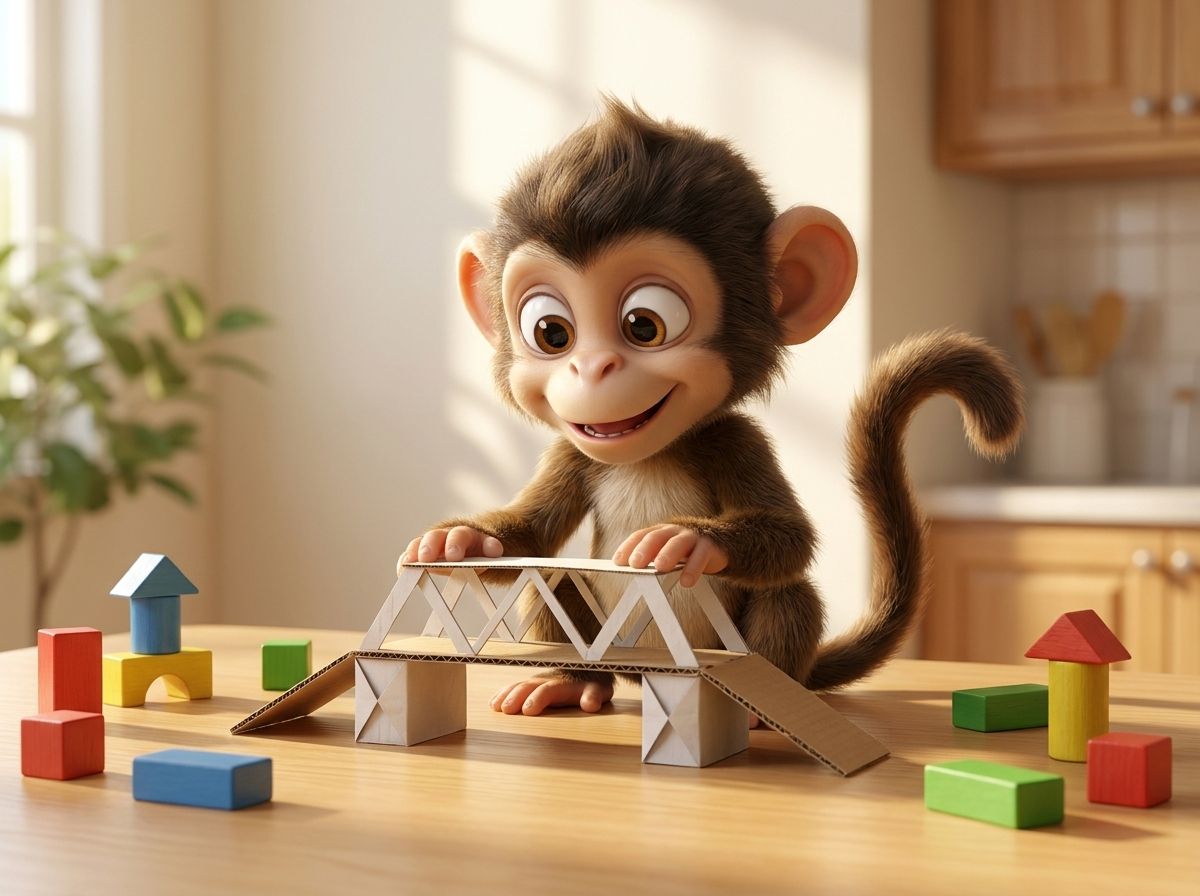
Confidence building activities for kids work best when children can experiment without feeling watched, rushed, or graded. Wix, Ziggyloo's curious monkey, offers a useful model: make one small change, notice what happens, and treat the result as information rather than proof of success or failure.
The goal is not to make every activity easy. That would leave very little room for learning. The goal is to make trying feel safe enough that your child can return after something goes sideways.
What Wix can teach about confidence
Wix is a good fit for conversations about experimenting because confidence does not have to arrive before the attempt. For many neurodivergent children, confidence grows during the attempt, especially when an adult quietly lowers the stakes around the outcome.
You might say, "Let's test one idea," instead of, "You can do this." Both sentences sound kind, but the first gives your child something concrete to do. The second can feel like a large promise when your child already expects the task to go wrong.
This matters for children with ADHD, autism, dyslexia, dyspraxia, and other forms of neurodivergence. A task may be within their ability but still feel hard because of noise, timing, working memory, handwriting demands, uncertainty, or the effort needed to shift from one activity to another.
The Child Mind Institute describes self-efficacy as a child's belief that they can handle a particular task. That is more specific than general confidence. A child may feel capable with drawing but uncertain with reading aloud, and you can build on that gap by giving them repeated experiences of handling one manageable challenge at a time.
Try using Wix's "one change" idea:
- Keep most of the activity familiar.
- Change only one part.
- Ask what your child noticed.
- Let your child choose whether to repeat or stop.
For example, Rowan's mum kept the paper, the table, and the bridge goal the same. She changed only the base from a narrow fold to a wide accordion fold. Rowan tested it with three toy cars. The bridge held one car, then two. It bent under the third, but Rowan did not throw it away. He said, "It needs a stronger middle."
That sentence was the confidence moment. You do not need to mark it with a speech. A quiet "You found something out" is often enough.
Why gentle experiments help neurodivergent children
Safe experimentation for children means the child has room to try without losing dignity, control, or access to a break. It does not mean removing every limit. You can still protect the table, set a time boundary, or say that paint stays on the paper.
The safety comes from making the result less personal. A failed tower is not "you can't build." A noisy sound experiment is not "you are being silly." It is a result from one attempt under one set of conditions.
A 2021 review in the journal Autism in Adulthood described how autistic people can experience pressure to appear comfortable in situations that are actually demanding. At home, you can reduce that pressure by accepting a child's communication about effort. A child who says "too much" may be giving you useful information, not avoiding learning.
You can build a small experiment around that information. If Sofia finds writing with a pencil tiring, invite her to test one sentence with a chunky pencil, a marker, or letter tiles. If the marker works better, that does not lower the learning. It gives Sofia a better route to the same idea.
Use language that keeps the result open:
- "What could we change?"
- "Which part felt hardest?"
- "Do you want another try, a different tool, or a break?"
- "What did that attempt tell us?"
Notice what is missing from those questions. You are not asking your child to prove that they are brave. You are not demanding a positive attitude. You are helping them gather evidence about what supports them.
And yes, sometimes the experiment ends with cereal on the floor and a grown-up stepping on a wooden block. Scientific progress has its hazards. You can still count the child's observation, their request for help, or their decision to stop as part of the learning.
Confidence building activities for kids that stay low pressure
You can turn ordinary home moments into gentle experiments. No special equipment, no worksheet, no cheerful soundtrack that makes everyone want to hide under the sofa.
The snack test
Place two spreads or toppings beside a familiar food. Let your child predict which texture they may prefer, then test a tiny amount. Your child can smell it, touch it, lick it, or decide not to taste it at all. The learning is about noticing and making a choice, not finishing the snack.
For Jamal, age 5, the experiment happened at the kitchen counter with toast. He disliked "surprise crunch," so his dad tested smooth sunflower butter and strawberry slices separately. Jamal chose the butter, then asked for the strawberry on a different piece. He learned that "not together" was a useful boundary. Small discovery, big deal.
The movement route
Choose a familiar path from the bedroom to the bathroom. Test one small change, such as walking backward for three steps, carrying a soft toy, or following floor spots. Stop if balance, noise, or silliness starts to feel uncomfortable.
This can help a child practise shifting attention without making transition practice feel like a command. You are not trying to make the route harder every time. You are learning which changes help and which ones make the morning wobble.
The building challenge
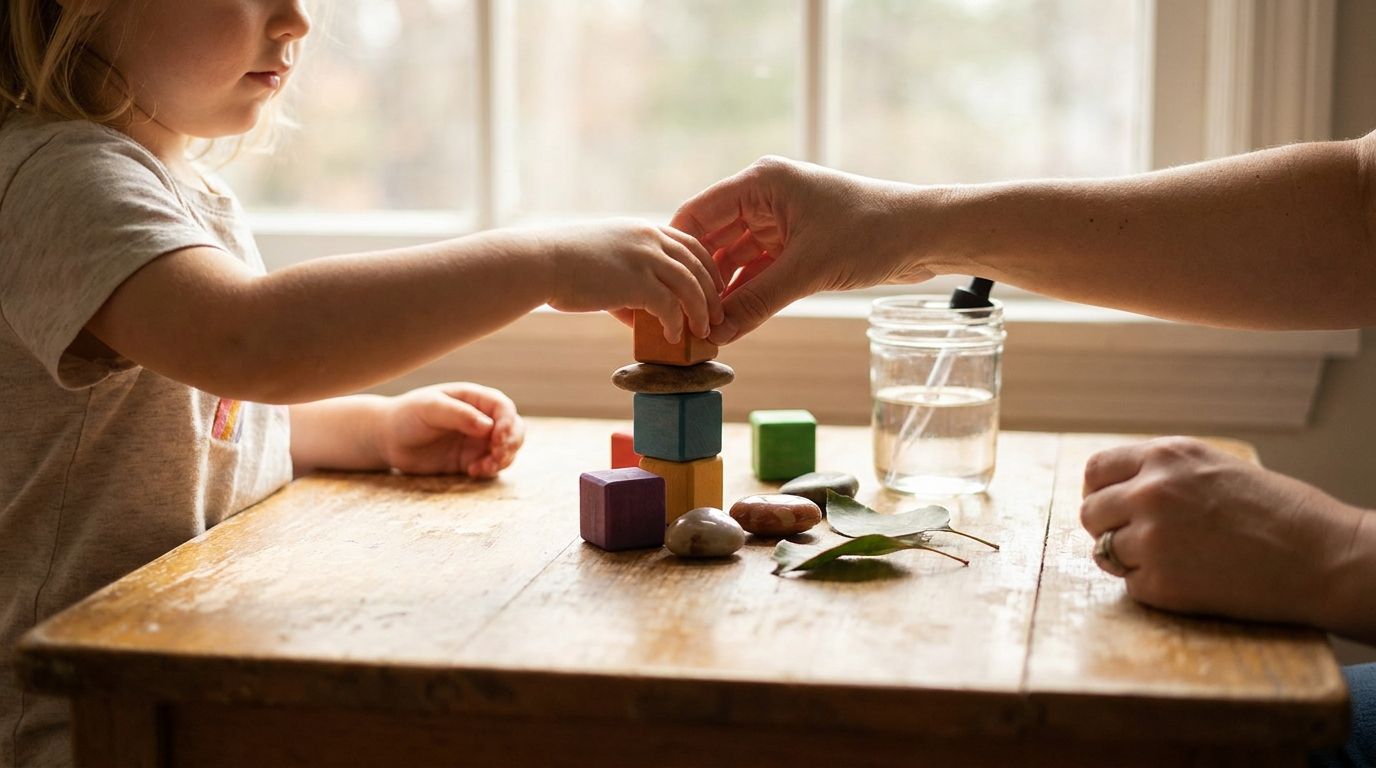
Offer blocks, cardboard, or magnetic tiles with a purpose such as "make something that holds a book." Before building, ask your child to choose the part they want to change if it falls. That choice gives them a plan for the moment when frustration arrives.
For Rowan, the plan was to widen the base. Another child might choose shorter pieces, a heavier bottom, or a break after each test. Each option supports problem-solving without turning the activity into a contest.
The sound and silence test
Use safe household sounds, such as tapping a spoon on a cushion and tapping it on a table. Keep the volume low. Your child can point to a picture, gesture, or use words to show which sound feels better.
This activity is useful for children who notice sound quickly. It also gives you information for future routines. If the table sound is too sharp, you can try a cushion during clean-up or choose a quieter signal for transitions.
These are growth mindset activities when they focus on flexible action rather than repeating a slogan. "I can try a new way" is more useful than "I never give up," especially when stopping is actually the sensible choice.
How to encourage neurodivergent children without adding pressure
Encouragement works best when it describes what your child did, noticed, chose, or communicated. General praise can feel pleasant, but specific feedback gives your child a map they can use again.
Instead of "You're so clever," try "You noticed the paper bent in the middle and changed the fold." Instead of "That was easy," try "You asked for a break before your body felt overloaded." The second sentence protects the child from feeling confused if the next attempt is harder.
A 2007 study led by Carol Dweck and Claudia Mueller found that the type of praise children receive can affect how they respond to challenge. Praise focused on traits, such as being smart, can make mistakes feel threatening. Feedback about choices and strategies leaves more room for another attempt.
That does not mean you must remove "I'm proud of you" from your vocabulary. Keep it. Just add a little detail around it.
Try this four-part response:
- Name the action: "You tested the wider fold."
- Name the information: "The bridge held two cars."
- Offer a choice: "You can adjust it or leave it here."
- Respect the answer: "Stopping is allowed."
A child may not respond with a neat lesson learned. They may grunt, wander off, or ask for a snack. The learning can still be there. Your job is not to force a reflection while the glue is wet and everyone is tired.
If your child refuses, lower the demand rather than increasing the pep talk. You might experiment yourself and narrate one observation: "The tower fell when I put the big block on top. I'm moving it lower." Your child can join later, or not. Modelling is an invitation, not a trap.
A gentle experimenting routine for busy days
You can use a five-minute routine when your child has enough energy for a small try. Pick a familiar activity and ask permission before changing it. That tiny pause gives your child a sense of control.
Say, "Would you like to test one small change?" If the answer is no, accept it. Confidence also grows when a child learns that their no is heard.
If your child says yes, follow this pattern:
Choose the familiar part
Use a game, snack, drawing task, story, or movement activity your child already knows. Familiarity saves energy for the experiment itself.
Pick one change
Change the tool, order, location, size, sound, or amount. Do not change everything at once. If the whole activity becomes new, you will not know what helped.
Make a prediction
Your child can speak, point, draw, gesture, or simply watch. "What do you think will happen?" is an invitation, not a quiz. You can make your own prediction too.
Test briefly
Set a small limit, such as one turn, two minutes, or three pieces. A clear ending can help children who find open-ended activities tiring.
Record the result in a simple way
Use words, faces, colors, or a quick photo without your child in it. "Better," "same," and "not for me" are enough. You are building a record of preferences, not creating a performance chart.
Choose what happens next
Your child can repeat, change one part, return to the familiar version, or finish. That final choice matters because it connects experimenting with self-knowledge.
Ziggyloo can support this kind of routine through its AI learning companion, which adapts conversations to a child and lets you review parent-visible transcripts. You can notice whether your child is asking for smaller steps, more repetition, or a different kind of prompt. The point is not to collect perfect attempts. It is to notice patterns that help you keep learning comfortable enough to continue.
When an experiment goes badly
A failed experiment can still be useful, but only after your child feels safe again. If the activity ends with shouting, tears, hiding, or a slammed door, skip the lesson for now. Offer water, quiet, pressure input if your child likes it, or a familiar calming activity.
Later, you can say, "That change was too much yesterday. We can leave it alone." This tells your child that learning does not require repeating a distressing experience. Full stop.
You can also separate the experiment from the child. "The room was too noisy for that game" is different from "You could not handle the game." "The instructions had too many steps" is different from "You were not listening." Accurate language protects confidence.
Consider what may have affected the result:
- Was your child hungry, tired, or coming home from school?
- Was the space crowded, bright, loud, or physically uncomfortable?
- Did the activity require several hidden steps?
- Did your child know how to ask for help or a pause?
- Was the experiment really optional?
For example, when 8-year-old Leah tried a new reading game after a long school day, she pushed the cards away and cried. Her mum initially thought the game was too hard. The next morning, Leah completed two rounds at the breakfast table with the cards spread farther apart. The reading skill had not changed overnight. The conditions had.
That distinction matters. Confidence is not a personality trait that some children receive in larger amounts. It is affected by access, timing, support, and past experiences, and you can change those conditions without asking your child to become a different person.
Building a home where trying is allowed
A child learns about experimentation from the atmosphere around ordinary mistakes. If a spilled drink brings a sharp reaction every time, your child may start hiding future spills. If you take one breath and say, "Let's get a towel," you teach that problems can be handled.
You do not need to be calm every minute. Parents are people, not softly lit woodland furniture. If you snap, repair it plainly: "I spoke too sharply. The spill was a problem, not a reason to scare you. Let's clean it together." Repair gives your child another example of trying a new response.
Make room for visible adult experiments too. Let your child hear you say:
- "I thought this recipe needed more flour. I was wrong."
- "That plan did not work, so I'm changing it."
- "I need a quiet minute before I answer."
- "I'm going to ask for help."
These statements show that adjusting course is ordinary. They also make help-seeking less embarrassing.
Create a small "try again" spot if your child enjoys visual reminders. It might be a tray with scrap paper, blocks, washable markers, or a familiar puzzle. Keep it optional. A child who sees the materials as another demand will not find the spot supportive.
You can also keep a private parent note with three headings: what helped, what was too much, and what to test later. After a week, you may notice that your child experiments more successfully before dinner than after it, with choices shown visually, or when you sit beside them instead of across from them.
That information is worth more than a broad label such as "not confident." It gives you a next move.
FAQ
What are good confidence building activities for kids?
Choose activities where your child can make a small choice, test one change, and stop without losing access to praise or connection. Building with blocks, testing textures, changing a drawing tool, and trying a short movement route can all support confidence when the result is treated as information.
How can I encourage my neurodivergent child without creating pressure?
Describe your child's action or observation instead of praising a fixed trait. Say, "You changed the base after it fell," rather than, "You are so smart." Always leave room for a break, a different tool, or a no.
What does safe experimentation for children look like?
Safe experimentation includes clear limits, familiar materials, adult support, and a genuine way to stop. You can protect physical safety and household boundaries while still letting your child choose how much to participate.
Are growth mindset activities helpful for autistic children or children with ADHD?
They can help when they focus on useful strategies, access needs, and flexible choices rather than forcing persistence. "Let's find what makes this workable" is often more supportive than asking a child to keep going through overload.
What should I do when my child refuses to try?
Accept the refusal and reduce the demand. You can offer a familiar version, model the experiment yourself, or return another day when your child has more energy. Refusal gives you information about readiness, comfort, or the task design.
Tonight, choose one familiar activity and offer one small experiment. Let your child pick the change, the length, or the ending. Then notice what happened without grading it. That quiet habit, repeated over time, can help your child learn that confidence is not the feeling they must wait for before trying. It is something they can build while finding a way that fits.
Join the conversation
Subscribe to comment
Join the Ziggyloo family newsletter to leave a comment — and get gentle learning tips and community stories in your inbox. No spam, unsubscribe anytime.