
Flicko and making multi-step learning feel more predictable
Flicko shows how small visual steps, steady routines, and gentle practice can make multi-step learning feel safer at home.
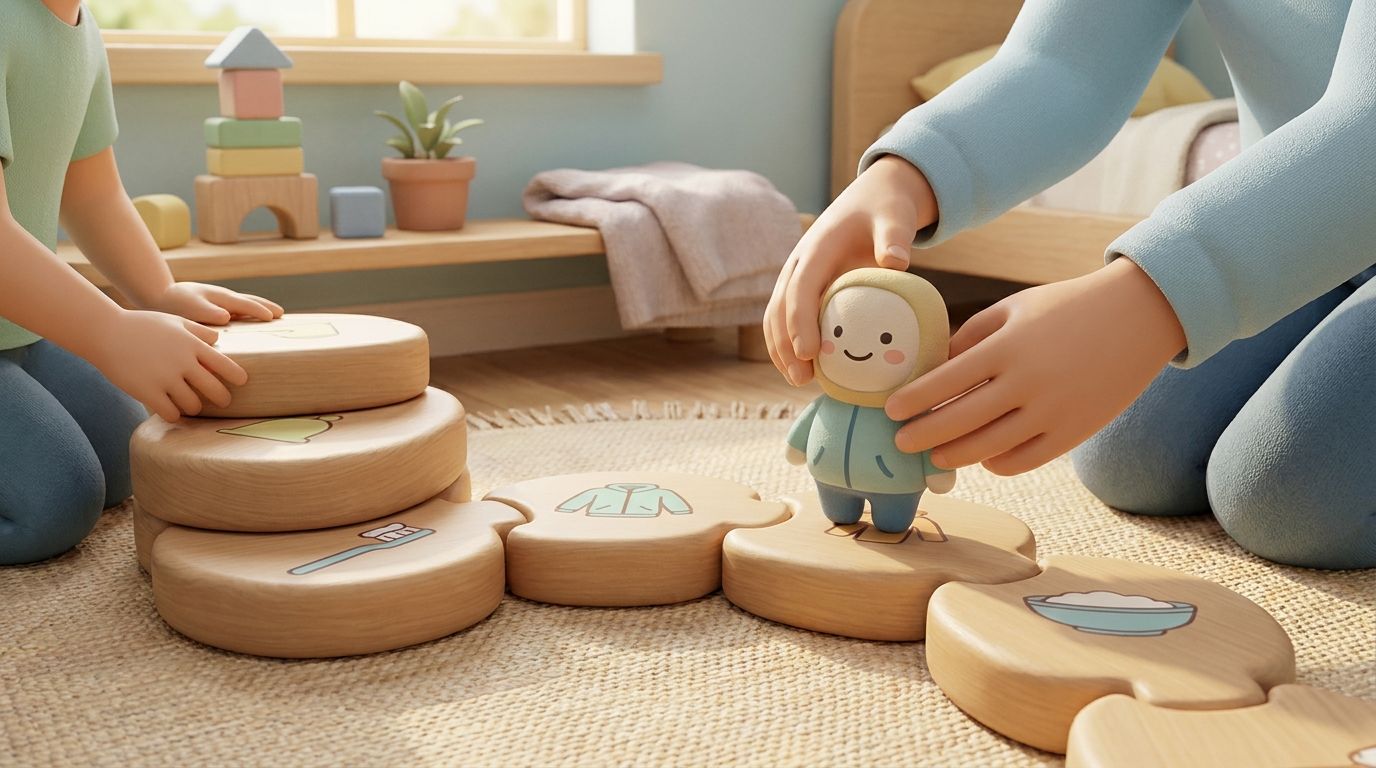
At 7:42 on a Tuesday morning, a cereal spoon hit the kitchen floor. Your child had been asked to get dressed, pack a bag, eat breakfast, and put on shoes. Four ordinary steps. One very big wall.
Multi-step learning activities for kids feel more predictable when you make the order visible, keep each step small, and leave room for pauses. Visual sequencing for neurodivergent children can lower the amount of information they have to hold in mind at once, while executive function activities at home can build planning skills without turning your kitchen into a tiny testing center.
That morning, Flicko would not have shouted, "Come on, you're late!" He would've helped make the next step easier to see.

Why multi-step learning can feel like one giant task
"Get ready for school" sounds short to an adult because you already know all the pieces tucked inside it. Your child may hear something much bigger: find clothes, decide what to wear, manage the feeling of changing, locate socks, remember the bag, check the lunchbox, put on shoes, and leave the room.
That is a lot of holding, shifting, planning, and starting. These skills live under the broad phrase executive function. In plain language, they help a person remember what matters, decide what comes next, begin an action, and switch when the plan changes.
The Harvard Center on the Developing Child describes executive function as a group of skills that help us plan, focus attention, remember instructions, and handle several tasks at once. Children do not build these skills by being told to "just remember." They build them through repeated practice with support.
And support does not mean doing everything for your child. It can mean placing the steps outside their head so their brain has less to carry.
A child might understand every part of a task and still struggle to complete the whole sequence. That is not laziness. It is not proof that you have explained it badly. Sometimes the path between "I know" and "I can do it now" needs a few stepping stones.
You may notice that multi-step tasks become harder when your child is hungry, tired, rushed, excited, or moving from one activity to another. The same child who breezes through a bedtime routine on Saturday may fall apart on a school morning. The skill did not vanish. The conditions changed.
What makes a sequence easier to follow?
A sequence usually feels more manageable when it has:
- A clear beginning your child can recognize
- One visible action at a time
- A predictable place for finished steps
- A pause or reset when attention runs out
You can also use the same words each time. "Shoes, then car" is easier to process than a fresh speech about being late, missing socks, and the library book that needs to go back today.
How Flicko helps us think about patience and progress
Flicko is paired with Bluster, and that pairing gives parents a useful picture. Bluster represents the storm that can arrive when a task feels demanding or unfair. Flicko represents the patience and warmth that make room for another try.
That does not mean a difficult moment has to become cheerful before learning can continue. Flicko is not asking you to paste a smile over frustration. He reminds you that progress can begin with lowering the size of the next ask.
You might say, "The whole routine feels like too much. Let's only find the shirt." Once the shirt is in hand, pause. Then name the next step: "Now trousers." No speech about the entire morning. No lecture from the Department of Why Are We Still Here (which, in my house, would have a very large budget).
This matters because your child can experience success before they finish the full routine. That small success carries real information: the task has an order, the order can be found, and a pause does not mean the whole plan is broken.
Try Flicko's four-part reset when a sequence starts to wobble:
- Notice the stuck point without blame
- Shrink the task to one action
- Show what happens after that action
- Give your child time to begin
The wording can stay simple. "You are stuck on what comes next. The next step is socks. I'll point to them." If your child needs help getting started, you can hand over the socks or place them beside the shoes. A prompt is a bridge, not a verdict about what your child can do.
What does predictable support sound like?
Predictable support is calm, brief, and repeatable. It does not require you to sound like a meditation recording while someone is crying into a backpack, it only needs to be steady enough that your child can recognize the pattern.
Useful phrases include:
- "Here is the next step."
- "You can pause after this part."
- "I will show you, then you can try."
- "The order changed, so we will check the picture."
The goal is not perfect independence every time. The goal is a routine your child can enter, leave, and return to without feeling lost.
Visual sequencing for neurodivergent children at home
Visual sequencing for neurodivergent children can take many forms: photos, simple drawings, objects placed in order, written words, or a small checklist. The best format is the one your child actually notices and uses.
For a tooth-brushing routine, you could place four pictures near the sink: toothbrush, paste, brush, rinse. For a cooking activity, you could line up the ingredients on the counter in the order they are needed. For getting ready to leave, a picture strip showing clothes, breakfast, bag, and shoes can do a lot of quiet work.
Keep the first version short. A ten-step chart may look wonderfully complete to you and feel like wallpaper to your child. Start with two or four steps, then add more only if the current sequence is already working.
Here is a simple way to build a visual sequence:
1. Choose one routine that causes repeated friction.
2. Watch what your child actually does, not what you wish they would do.
3. Break the routine into actions that can be seen or touched.
4. Put the actions in order and let your child move, turn, or remove each finished step.
The last part matters. A finished step should look finished. Your child might move a card into a "done" pocket, flip a picture over, or drop an object into a basket. That physical change makes progress concrete rather than invisible.
You can make the visuals less demanding by keeping them nearby rather than pointing at them every ten seconds. Offer the chart as a helper. If your child ignores it, that is useful information. Maybe the pictures are too small. Maybe there are too many. Maybe the routine needs a movement break between steps.
A visual schedule is not a test your child can fail. It is an external memory. If the format does not help, change the format.
When should you use words, pictures, or objects?
Use the form your child can understand during the actual routine, not only when they are calm at the table. Some children respond to photos because photos show the exact shirt, cup, or bag. Others do better with icons, written words, or real objects they can handle.
You can test a format by watching for three signs:
- Your child looks toward it without repeated prompting
- Your child can identify what comes next
- Your child can mark a finished step in some way
If none of those signs appear, reduce the number of steps or try a different kind of cue. A visual tool should make the path clearer, not create another task for you to manage.
Executive function activities at home that do not feel like drills
Executive function activities at home can grow out of ordinary routines. No special workbook required. No perfectly cleared table. Your child can practice planning while building a snack, packing a toy bag, setting up a bath, or getting a favorite game ready to play.
The activity works best when you make the plan visible and let your child take part in deciding the order. Offer two choices instead of an open-ended question that creates even more to process.
Try these everyday activities:
- Pack a small outing bag with a picture list and let your child check each item.
- Make toast or fruit salad with one instruction card visible at a time.
- Build a block design from a finished model, with permission to change it.
- Set up a bedtime basket containing the objects needed for the routine.
Each activity gives your child practice with remembering, starting, checking, and finishing. It also gives you a chance to notice where support belongs. Maybe your child plans well but cannot begin. Maybe they begin quickly and skip the checking step. Maybe transitions are the hardest part.
You can adjust the task without treating the adjustment as a failure. Use fewer ingredients. Put the bag on the chair. Offer a five-minute warning before switching. Keep the finished example nearby. The point is not to make every activity challenging. The point is to help your child experience a sequence that makes sense.
Ziggyloo can support this kind of practice through its AI learning companion, which adapts conversations to your child and lets you review transcripts. You might notice that your child handles a two-step prompt but needs more support when the language becomes longer. That observation can help you keep home practice current without guessing from one difficult morning.
You can also use the Story library and reader for sequence talk. After a story, you might ask what happened at the beginning, what changed next, and what the character did afterward. If your child prefers creating rather than retelling, StorySpark Studio can offer another way to arrange events without making the activity feel like a worksheet.
Keep the questions light. "Which part came next?" is often easier than "Tell me the whole story in order." Your child can point, choose, act it out, or use a few words. Sequence knowledge does not always arrive as a spoken answer.
Making routines predictable without making them rigid
Predictability and flexibility can live in the same home. A routine can have a familiar shape while still bending for sensory needs, low energy, or an unexpected change.
You might keep the order of a morning routine steady but offer two clothing choices. You might keep the bedtime steps the same but allow your child to brush teeth before pajamas on a tired night. You might show a "change" card when the usual plan cannot happen.
This helps your child learn that a change can be named and handled. The message becomes, "The plan is different, and we can find the new next step," rather than, "Everything is ruined."
A flexible sequence can include:
- A usual path for ordinary days
- A shorter path for low-energy days
- A pause symbol for sensory or emotional overload
- A change symbol for unexpected events
You do not have to prepare a card for every possible surprise. That way lies a very fancy binder and a parent who needs a nap before lunch. Choose the changes that happen often enough to deserve a simple plan.
When your child gets stuck, check the demand before adding more words. Is the task too long? Is the room noisy? Is the next item out of reach? Is the transition happening too quickly? A small environmental change may do more than another explanation.
And if the routine falls apart, you can return later. Practice does not have to happen at the moment of maximum distress. Flicko's patience includes your patience with yourself.
How can you celebrate progress without creating pressure?
Name what happened in a specific way. "You checked the picture after the plan changed." "You found the next step after your break." "You finished the first part and asked for help." These comments tell your child exactly what their effort accomplished.
You can use a small reward, a favorite song, a cuddle, a movement break, or a few minutes in an interest-based activity. The reward does not need to be large. The sense of completion can be enough when the task has already taken a lot of energy.
Notice attempts, not only finished routines. A child who begins one step after a difficult pause is practicing. A child who points to the next picture is communicating. A child who says "help" before throwing the whole basket is building a bridge.
FAQ
How many steps should a visual sequence have?
Start with two to four steps for a routine your child already finds difficult. Add steps only when your child can use the current sequence with less support. A shorter chart that gets used is more helpful than a complete chart that gets ignored.
Are multi-step learning activities suitable for children with ADHD?
Yes, when the activity matches your child's attention, energy, and processing needs. Use short sequences, visible materials, movement breaks, and clear finish points so your child does not have to hold the entire plan in working memory.
What if my child refuses to use a visual schedule?
Treat refusal as information rather than defiance. Try fewer steps, a different format, or a routine your child enjoys more, and offer the visual as a helper instead of requiring your child to perform for it.
How can I practice sequencing without making learning feel like work?
Use routines your child already cares about, such as making a snack, setting up a game, or creating a story. Let your child point, move objects, act out the order, or choose between options instead of requiring spoken answers.
The next time a routine feels too big, you do not have to solve the whole morning. Put the first step where it can be seen. Offer a pause. Say less. Let Flicko remind you that patience is not standing still, it is making enough room for the next attempt.
And if the cereal spoon hits the floor anyway, you are still allowed to call that a learning moment. You and your child are not behind. You are finding the shape of support that lets the next step become possible.
Join the conversation
Subscribe to comment
Join the Ziggyloo family newsletter to leave a comment — and get gentle learning tips and community stories in your inbox. No spam, unsubscribe anytime.