
The Pattern Plateau: Math Skills Built from Visual Tricks
If your child can spot a pattern but not use it for math, this is your next win. Try these visual tricks in Ziggyloo biome moments.
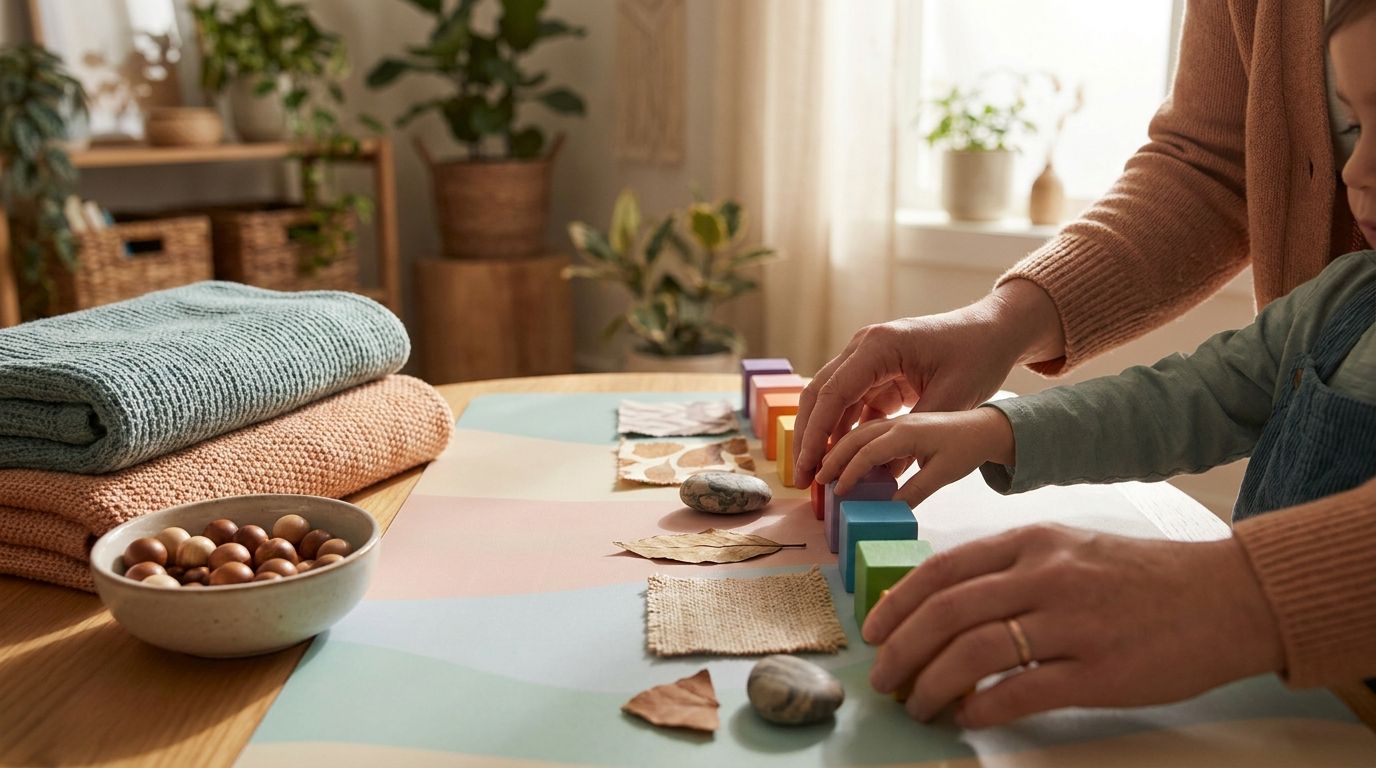
You pour cereal into a bowl and your child lines up the spoon beside it, then the cup, then the spoon again. You think, "Okay, we're making a tiny pattern," and then you realize you just got a math lesson for free. The idea is simple: when math feels stuck, visual pattern games are a bridge from "I see it" to "I can use it."
This post is about the Pattern Plateau, the moment many neurodiverse kids hit when they can recognize patterns but struggle with the next step, like counting, predicting, or solving. We'll build that bridge using learning through play and visual learning, including patterns activities you can repeat in real life and in the Ziggyloo biome.
What the Pattern Plateau looks like (and why it happens)
The Pattern Plateau is when your child can spot a pattern in front of them, but the pattern does not travel to math tasks that use the same idea. You might see it like this:
- Your child copies a bead pattern perfectly, then freezes when asked, "What comes next?"
- They can count to a number they love, then feel blocked when you ask them to count groups in a worksheet-like way.
- They play a "find the pattern" game, but do not apply it when the pattern shows up inside a word problem.
This usually is not a "can't" problem. It is often a "too many steps at once" problem. Many neurodiverse kids process visual information strongly, but when math asks them to juggle several moves at the same time, the brain gets overloaded. Research on learning and attention keeps pointing back to one theme: kids learn better when they can see, test, and adjust rather than hold everything in working memory at once.
So you do not need to push harder. You need to change the format.
In Ziggyloo biome moments, you can aim for a simple cycle: show the pattern clearly, let your child predict with support, and let them "check" by looking, moving, or placing. When the check is built in, the brain stops guessing and starts learning. That is the payoff of visual learning.
A quick check you can do today
Pick a familiar pattern your child already likes. Ask for only one move: "Show me the next one." If they can do it when they can point or place, you are on the right track. If they can't, scale down the pattern length and keep it concrete.
Visual learning tricks that turn patterns into math
Visual learning is not just "pretty pictures." It is a way to make thinking visible. When your child can see the structure, they can use it without carrying as much in their head.
Here are visual learning tricks that map directly onto math skills for neurodiverse kids.
Trick 1: Use "place it" patterns, not "say it" patterns
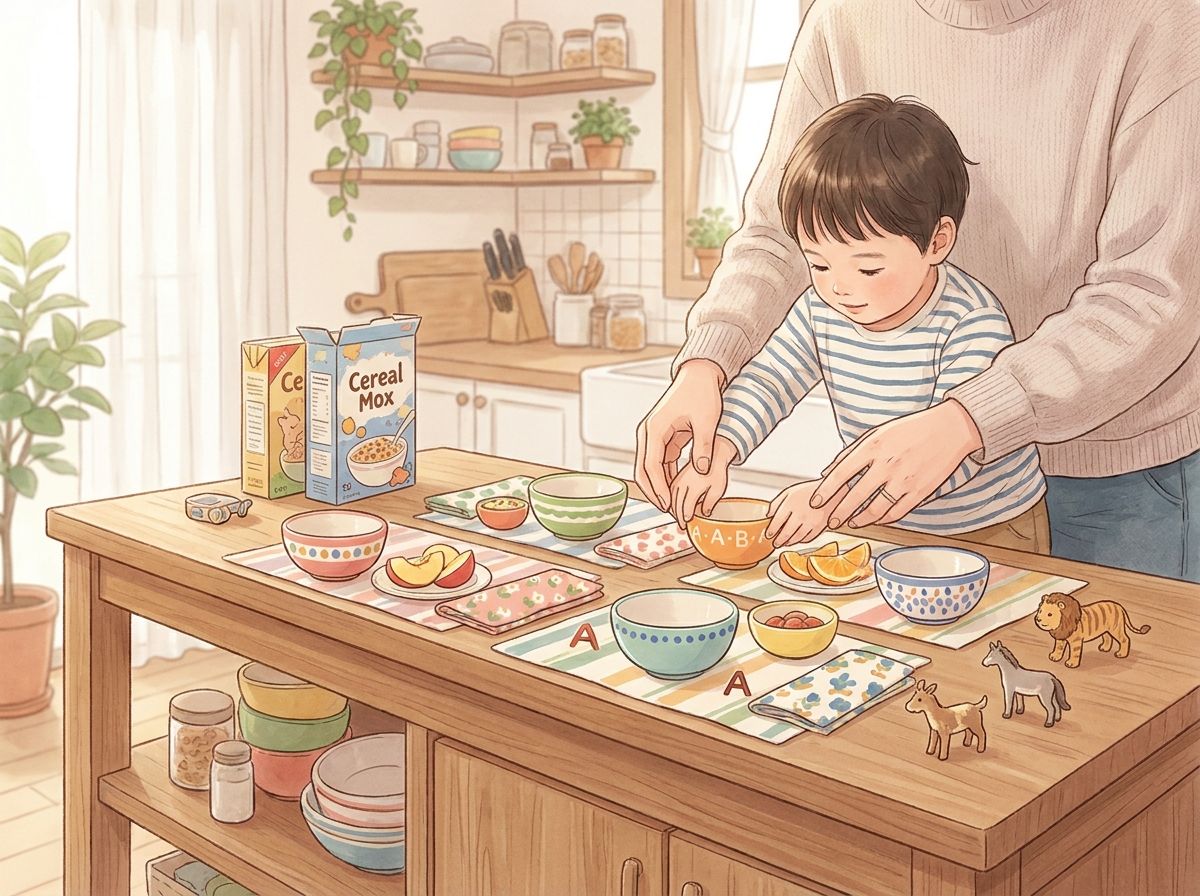
In the kitchen, you can build a repeat pattern with objects that do not move too fast. Try plates, napkins, blocks, or cereal pieces. Then ask your child to place the next item instead of saying the answer.
Scenario: On a Tuesday morning, you and your child stand at the counter. You make a pattern with two spoons and one cup: spoon, cup, spoon, cup. You pause. You do not ask for a sentence. You point to the empty spot and wait. Your child places the next cup. That placement is the math skill.
Then you add one tiny math step: "We made 2 repeats. How many cups is that?" Now the pattern becomes counting.
Trick 2: Add a "window" so the pattern stays in view
Many kids can handle patterns when the pattern is small and framed. A window can be a piece of paper, a tray, or even tape on the floor that marks where the pattern lives.
Scenario: In the living room, your child sits on the rug. You place painter's tape in a rectangle. You build a pattern inside the rectangle with two objects that contrast, like a toy car and a mini dinosaur. You slide the "window" forward after each repeat. Your child sees the next step because it is always inside the frame.
Trick 3: Use color and shape as "math handles"
If your child gets stuck with numbers, you can still teach the math idea using shapes. Circles can stand for "1," squares can stand for "2," and triangles can stand for "3." Your child is not learning "shapes instead of math." They are learning how to group.
Scenario: At the table, you draw three shapes in a row: circle, square, circle, square. Your child colors the next two shapes to match. Then you ask, "How many circles do we have?" That is a counting move hiding inside a patterns activity.
Trick 4: Make prediction a "try and check" moment
Prediction feels scary when there is only one correct answer. Try-and-check makes it playful. You can say, "Let's guess, then we'll peek." After your child predicts, you reveal the next piece and let them see if the guess worked.
With Ziggyloo's adaptive learning system, the games often give that built-in check through visual steps, so your child can learn the pattern without the pressure of holding it in their head.
The Pattern Plateau in the Ziggyloo biome: how to use it at home
The Ziggyloo biome is not just a background. It is a structure for learning through play. When you use the biome idea at home, you create a "math place" where patterns feel safe.
Think of it like this: your child does not need a new worksheet. They need a new setting.
Set up a "math corner" that looks the same every time
Pick one spot. It can be the same tray on the kitchen table or a small area on the floor. Keep the tools consistent: small objects, sticky notes, colored paper, or blocks.
When the environment stays stable, your child spends less energy on switching, and that matters a lot for attention and learning.
Make the pattern goal visible
Instead of "Let's do math," try a phrase that matches the visual goal. You can say:
- "Let's build the repeating row."
- "Let's find the next one."
- "Let's count the repeats."
When the goal is visual, your child can aim at something concrete.

Match the game to the moment your child is in
Some days your child wants speed. Other days they want slow. You can match the pattern activity to the mood.
Here are three home moments that often show up:
- Morning energy: Do quick pattern rounds with 3 to 5 items.
- After-school slump: Use longer breaks and fewer items, like a repeating two-item pattern.
- Wind-down time: Do pattern "checklists" with paper and stickers.
Scenario: Friday night, your child is tired. You keep the pattern tiny: spoon, cup, spoon, cup. You ask for only one placement. Then you stop. Later, you do a counting question: "How many cups did we use?" That is enough math for the day.
Keep the pattern length on purpose
A good rule is to start with what your child can do. If they can handle AB repeating, keep it AB. If they can handle ABAB, keep it ABAB. When they struggle, shorten the pattern and rebuild.
This is how you move through the Pattern Plateau instead of getting stuck in it.
Patterns activities that build specific math skills
Now let's connect patterns activities to math outcomes you actually care about. The goal is not "patterns for patterns' sake." It is to build skills like counting, predicting, and understanding number relationships.
Skill 1: Counting groups (without turning it into a worksheet)
Use repeating patterns to create groups. When your child sees repeats, counting becomes easier.
Try this:
- Make a pattern with 2 colors, like red-blue-red-blue.
- Ask, "How many reds?"
- Ask, "How many repeats did we make?"
Why it works: the repeat acts like a unit. Many kids find units easier than counting scattered items.
Skill 2: Number prediction (the "what comes next" bridge)
Prediction is the math brain's warm-up. When prediction is visual and low-stakes, it becomes a habit.
Try this:
- Build a pattern with one missing spot.
- Ask for the missing item to be placed.
- Reveal and celebrate the check.
Scenario: In the hallway, you line up three toy cars in a pattern: red, blue, red, blue. You leave the last one empty. Your child places a blue car. You say, "We checked it. It matched." Then you ask one more thing: "If we add one more repeat, what color comes next?"
Skill 3: Early multiplication thinking (as "repeats")
You do not need to teach multiplication as a rule. You can teach repeats as groups.
Try this:
- Make 4 repeats of a pattern with 2 items each.
- Count the items by repeats.
Example: If your pattern is circle-square and you make 4 repeats, you have 4 circles and 4 squares. That is a foundation for grouping.
Skill 4: Understanding odd and even (through leftovers)
Odd and even can feel abstract. Visual patterns make it concrete.
Try this:
- Build a pattern that alternates two items.
- Stop after an odd number of items.
- Ask, "What do we have left? Who is 'missing'?"
Scenario: At the table, you alternate stickers: star-heart-star-heart-star. Your child looks at the last one and says, "Star." You ask, "So is star the one that comes after heart today?" You are teaching parity through a visual story.
Skill 5: Problem solving (because patterns invite choices)
Patterns activities are naturally choice-based. That supports learning through play because your child can explore.
Try this:
- Give two pattern options.
- Ask, "Which one matches the rule?"
You can make the rule visible with a color cue. Your child learns to test, not guess.
How to handle the stuck moments without making pressure bigger
Let's talk about what happens when it stops working. Because it will, sometimes.
You might see frustration when the pattern gets longer than your child can hold, the pattern changes too quickly, or the question turns into "Explain your thinking." A lot of parents accidentally make it harder by asking for a verbal explanation too soon. For many neurodiverse kids, the verbal step comes after the visual step. Always. (I know that can feel backwards, but stick with it.)
So you can adjust.
Lower the language load
Keep questions short. Swap "Tell me the rule" for "Show me the next one."
If your child is ready, you can add a simple phrase later: "It repeats." But you do not have to rush.
Use "support then fade"
Support might look like:
- pointing to the next empty space
- offering two choices
- giving a visual cue like a highlighted color
Then you fade it. You remove the cue once your child starts succeeding.
Keep a "reset script" for Pattern Plateau days
When your child gets stuck, you can say the same thing each time. Consistency helps.
Try:
- "We are going to make it smaller."
- "We are going to use the window."
- "You can place it. No talking needed."
That last line matters. It gives permission.
Watch for learning fatigue signals
If your child is showing signs of fatigue, you do not need a tougher game. You need a shorter one.
A quick guide:
- If your child's body gets fidgety, shorten the pattern.
- If they avoid the materials, swap to a familiar pattern.
- If they get tearful, stop the task and do a check-only round.
Research on learning and attention often points to the same practical truth: breaks and reduced task demand help children stay engaged. You can feel that in your kitchen.
A real-life moment you can borrow
Scenario: Your child is building a repeating pattern with blocks. You ask for prediction, and they slam the blocks down. Your instinct is to "fix" it with more instruction. Instead, you do a reset. You rebuild the pattern exactly as before, then ask for only one placement. The emotion drops because the task becomes doable again.
That is not giving up. That is teaching your child how to learn.
FAQ
Why does my child recognize patterns but struggle with math questions?
Your child might recognize patterns visually, but math questions often ask for extra steps at the same time, like holding information in mind or switching formats. When you slow it down and keep the pattern visible, the math idea becomes easier to use.
What patterns activities work best for ages 3 to 6?
Use short repeating patterns with clear visual units, like AB repeats using two objects. Focus on "place it" prediction and counting the repeats. Keep sessions brief so it stays playful.
How do I know if I should shorten the pattern?
If your child stops placing items, avoids the materials, or becomes upset right after the pattern changes, shorten it. Go back to a pattern length they already succeed with, then add one item only when they seem comfortable.
Can visual learning help neurodiverse kids with more than one math skill?
Yes. Visual pattern games can support counting groups, prediction, and early ideas about odd and even. When you connect the pattern to a single math question, your child gets practice with the skill you want.
What should I do if my child refuses to explain answers?
Let placement be the answer. You can ask, "Show me," instead of "Tell me." Explanation can come later, after the visual step feels secure.
Your next step: build one Pattern Plateau bridge this week
Pick one day this week and choose one repeating pattern that your child already likes. Set up a small "window" on a tray or taped rectangle, build the pattern with 4 to 6 items, and ask for only one placement. Then ask one counting question tied to the pattern, like "How many reds?"
If you do that once, you are not just doing a fun activity. You are teaching your child that their visual strengths turn into math skills.
Join the conversation
Subscribe to comment
Join the Ziggyloo family newsletter to leave a comment — and get gentle learning tips and community stories in your inbox. No spam, unsubscribe anytime.